GUID Generator
Generate Microsoft-style GUIDs instantly - uppercase, braces, or hyphenated. Built for .NET, C#, SQL Server & Windows. 100% client-side. No signup needed.
What Is a GUID?
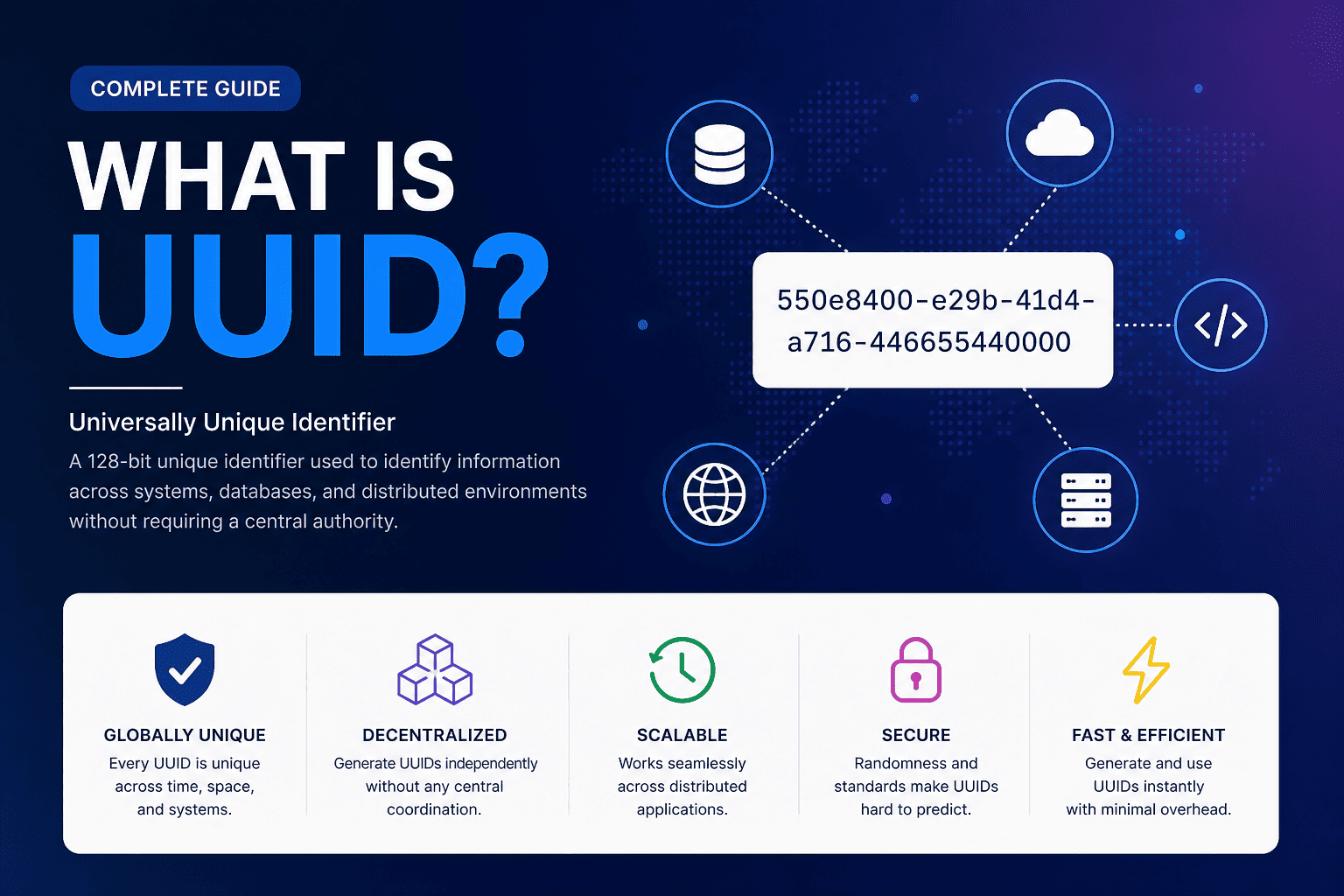
A GUID (Globally Unique Identifier) is Microsoft's implementation of the UUID standard - a 128-bit random identifier used to uniquely identify objects across software systems, databases, and Windows services. Structurally, a GUID is identical to a UUID v4: 32 hexadecimal digits arranged in five groups separated by hyphens, covering a total address space of 2¹²² unique values (approximately 5.3 × 10³⁶ possibilities). The only practical differences are cosmetic - GUIDs are conventionally displayed in uppercase and often wrapped in curly braces in Windows and .NET contexts.
A typical GUID looks like: {550E8400-E29B-41D4-A716-446655440000}. Remove the braces and lowercase the characters, and you have a standard UUID: 550e8400-e29b-41d4-a716-446655440000. They represent the same 128-bit value.
GUID vs UUID - Are They the Same?
Technically, yes - a GUID and a UUID are the same thing. Microsoft introduced the term "GUID" in the early 1990s as part of the Component Object Model (COM) and Distributed COM (DCOM) specifications. Simultaneously, the Open Software Foundation (OSF) was developing UUID for the Distributed Computing Environment (DCE). Both converged on the same 128-bit format.
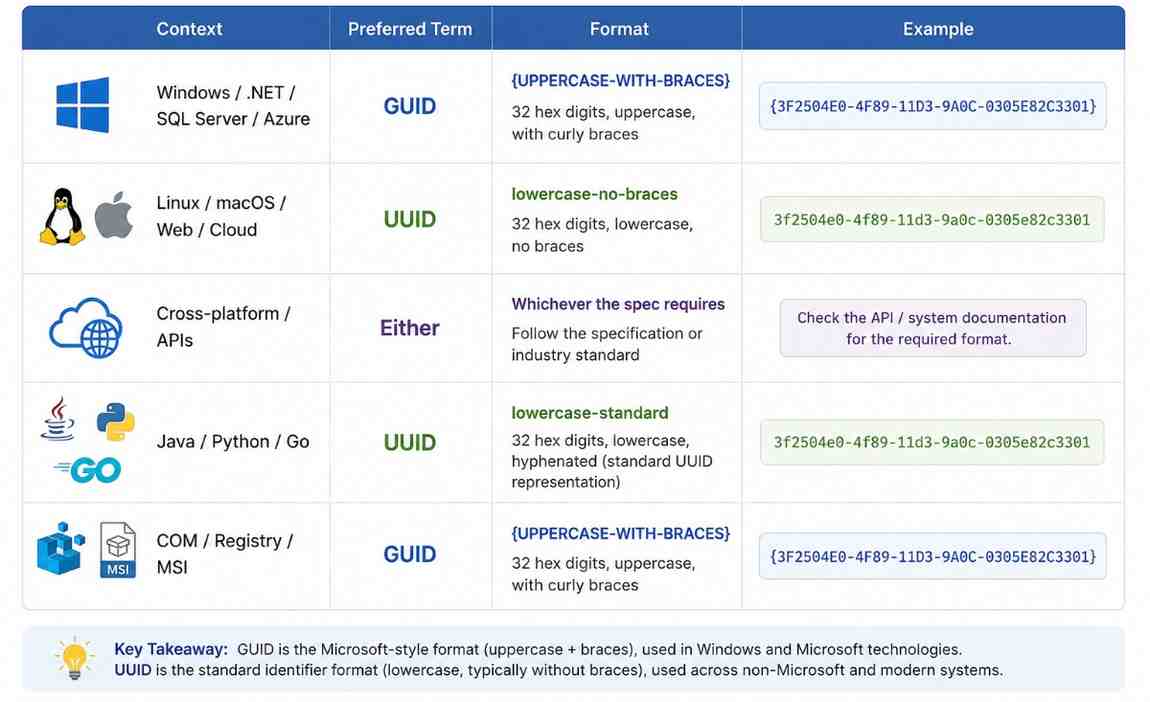
RFC 4122 (published 2005) formally unified the two terms. Section 3 states explicitly: the terms "GUID" and "UUID" are used interchangeably. In practice, the terminology split is purely ecosystem-based:
How to Generate a GUID - Code Examples in 5 Languages
Our free online GUID generator handles bulk generation in-browser with zero server calls. But if you need to generate GUIDs programmatically inside your application, here are production-ready examples across the most common languages and platforms.
C# / .NET — System.Guid
SQL Server - UNIQUEIDENTIFIER
Python - uuid Module
JavaScript / Node.js - crypto module
PowerShell - [System.Guid]
GUIDs in the .NET Ecosystem
In C# and .NET, System.Guid is a first-class value type (struct) - not a class - which means it is stack-allocated, zero-overhead for garbage collection, and inherently immutable. This makes it ideal for use as a primary key type in high-throughput applications. Guid.NewGuid() internally calls the Windows CoCreateGuid API, which is backed by CryptGenRandom - the same CSPRNG used for TLS certificates and cryptographic key generation. It is fully cryptographically secure and appropriate for security-sensitive identifiers.
Entity Framework Core automatically maps Guid properties to UNIQUEIDENTIFIER columns in SQL Server, uuid columns in PostgreSQL, and CHAR(36) or BINARY(16) in MySQL - type across all major .NET-supported databases.
GUIDs in SQL Server - Performance Considerations
SQL Server's UNIQUEIDENTIFIER type stores GUIDs as 16 bytes — the most compact binary representation possible. However, using NEWID() (random GUID) as a clustered primary key introduces index fragmentation because each new row inserts at a random position in the B-tree index, causing frequent page splits. For write-heavy tables, this can reduce insert performance by 30–40% compared to sequential integer keys.
The three approaches and their tradeoffs:
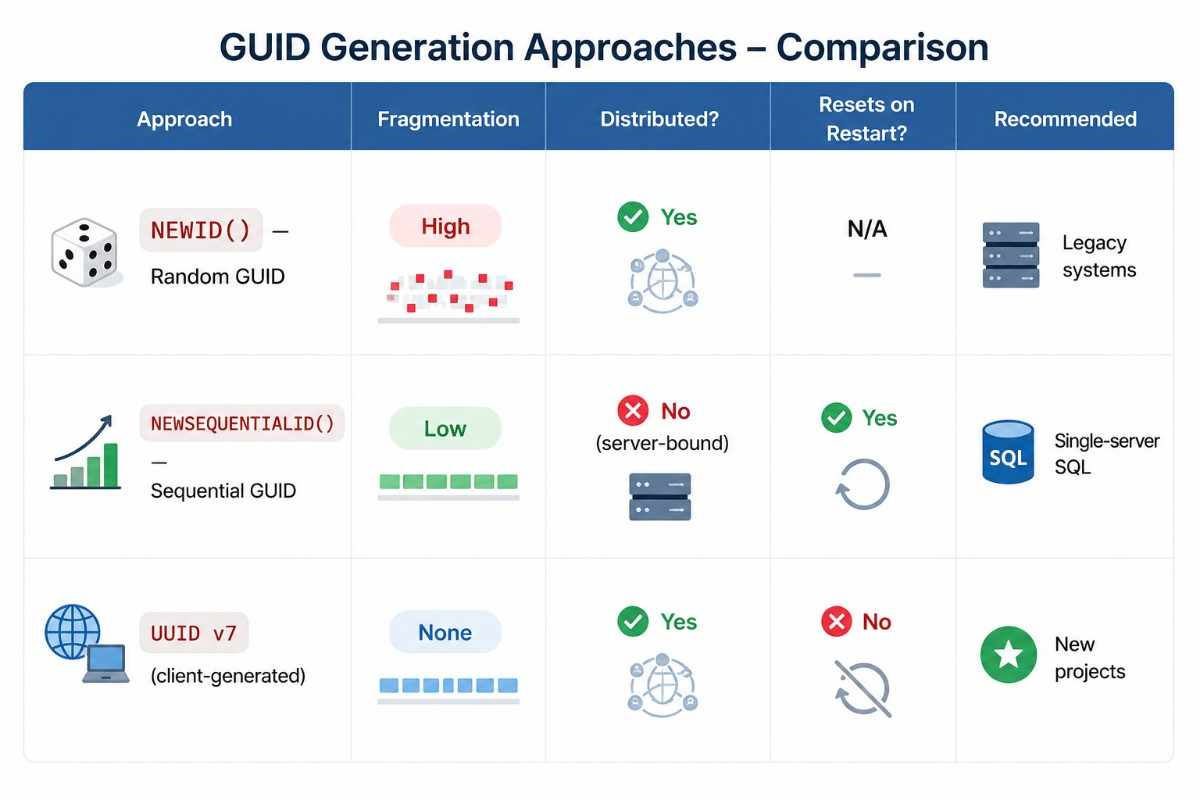
For modern SQL Server applications, generating a UUID v7 client-side and inserting it as a UNIQUEIDENTIFIER gives you the best of all approaches: time-ordered (sequential) insertion order, cross-distributed-system compatibility, and no server-restart resets. UUID v7 is specified in RFC 9562 (2024) and is supported natively in PostgreSQL 17, MySQL 9.0, and MariaDB 10.7+.
GUIDs in Windows Registry and COM
GUIDs are the foundational identity mechanism of the Windows operating system. The Component Object Model (COM), introduced with Windows NT 3.1, uses four distinct types of GUIDs to identify every software component registered on the system:
CLSID (Class ID) - Identifies a COM class implementation. Stored under
HKEY_CLASSES_ROOT\CLSID\{GUID}. Every ActiveX control, Shell extension, and in-process server has a CLSID.IID (Interface ID) - Identifies a COM interface definition. Every interface (IUnknown, IDispatch, etc.) has a unique IID that is identical across all Windows systems worldwide.
LIBID (Library ID) - Identifies a type library (.tlb file). Used by Visual Basic 6, early VBA, and legacy automation tools.
APPID (Application ID) - Identifies a DCOM server application and its activation and security settings.
When you install software on Windows, the MSI installer registers CLSIDs in the registry and assigns a ProductCode GUID (stored in HKEY_LOCAL_MACHINE\SOFTWARE\Microsoft\Windows\CurrentVersion\Uninstall\{GUID}) that uniquely identifies the product and version across all machines worldwide.
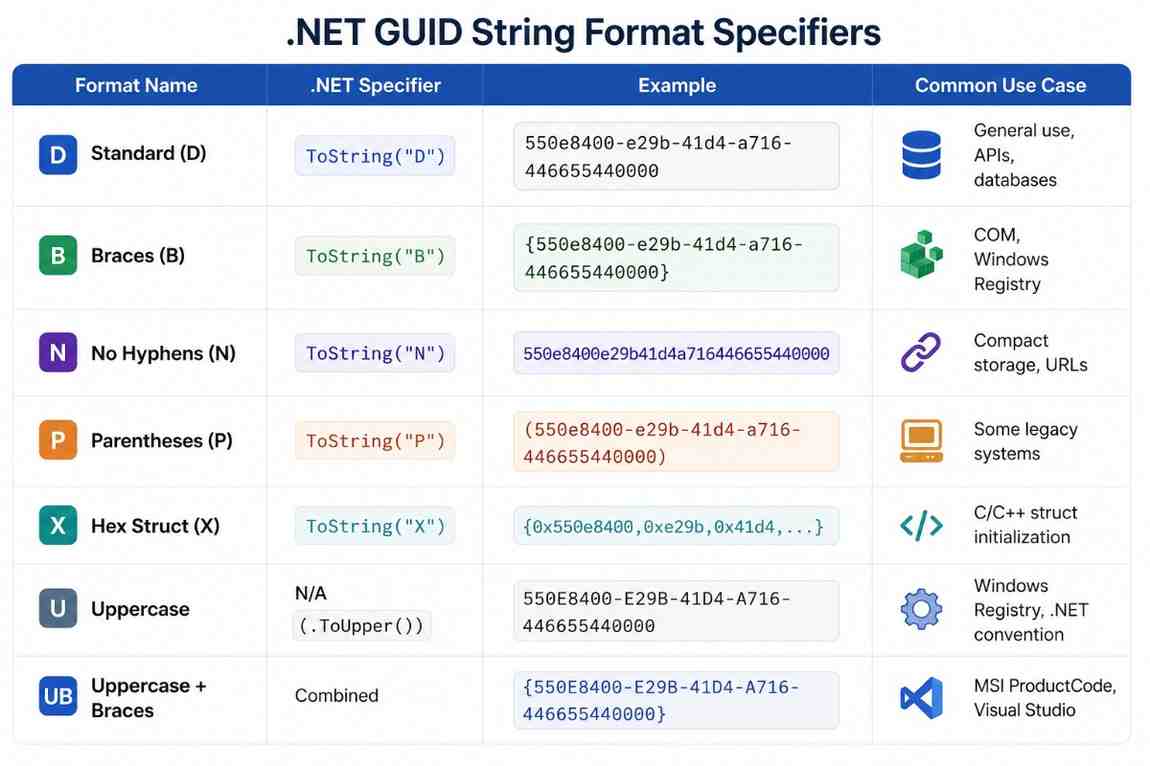
GUID Format Reference - All Supported Formats
Our online GUID generator supports all standard Microsoft formats. Use the Uppercase and Wrap in Quotes options to match your target platform's convention.
Common Use Cases for GUIDs
GUIDs are the default identifier type for a wide range of Microsoft-ecosystem and enterprise systems:
SQL Server primary keys -
UNIQUEIDENTIFIERcolumns withNEWID()or pre-generated client-side GUIDs. The most common GUID use case in enterprise applications..NET Entity Framework -
Guidproperties automatically map toUNIQUEIDENTIFIERin SQL Server,uuidin PostgreSQL, and binary in MySQL.Azure services - Azure Resource Manager (ARM), Azure Active Directory (Entra ID), Azure Service Bus, and virtually all Azure APIs use GUIDs as resource identifiers and tenant/subscription IDs.
MSI installer packages - Every Windows installer has a
ProductCodeGUID identifying the product and aUpgradeCodeGUID linking versions together for upgrades.Visual Studio project files - Every
.csproj,.vbproj, and.slnfile contains GUIDs to uniquely identify projects and solution configurations across developer machines.ASP.NET session and anti-forgery tokens - GUID-based tokens for CSRF protection and distributed session management.
SignalR connection IDs - GUIDs identify WebSocket connections in real-time .NET applications.
Microsoft 365 / SharePoint - List items, documents, site collections, and user accounts all use GUID identifiers internally.
GUID Collision Probability - Is It Actually Unique?
A GUID v4 contains 122 bits of cryptographic randomness (6 bits are fixed for the version and variant markers). The total number of possible GUIDs is 2¹²² ≈ 5.3 × 10³⁶. To put that in perspective:
If every person on Earth (8 billion people) generated 1 billion GUIDs per second, it would take approximately 85 years before a collision became statistically likely - and even then, the probability would be roughly 50% only after that timeframe.
In practice, generating even 1 trillion GUIDs produces a collision probability of approximately 1 in 5.3 × 10²⁴ - effectively zero for any real-world system.
GUID uniqueness relies entirely on the quality of the underlying CSPRNG. This generator uses the browser's crypto.getRandomValues() API - the same cryptographically secure random number generator used for TLS key generation - making collision probability negligibly small for any practical workload.
When to Use GUID vs UUID v7 vs ULID
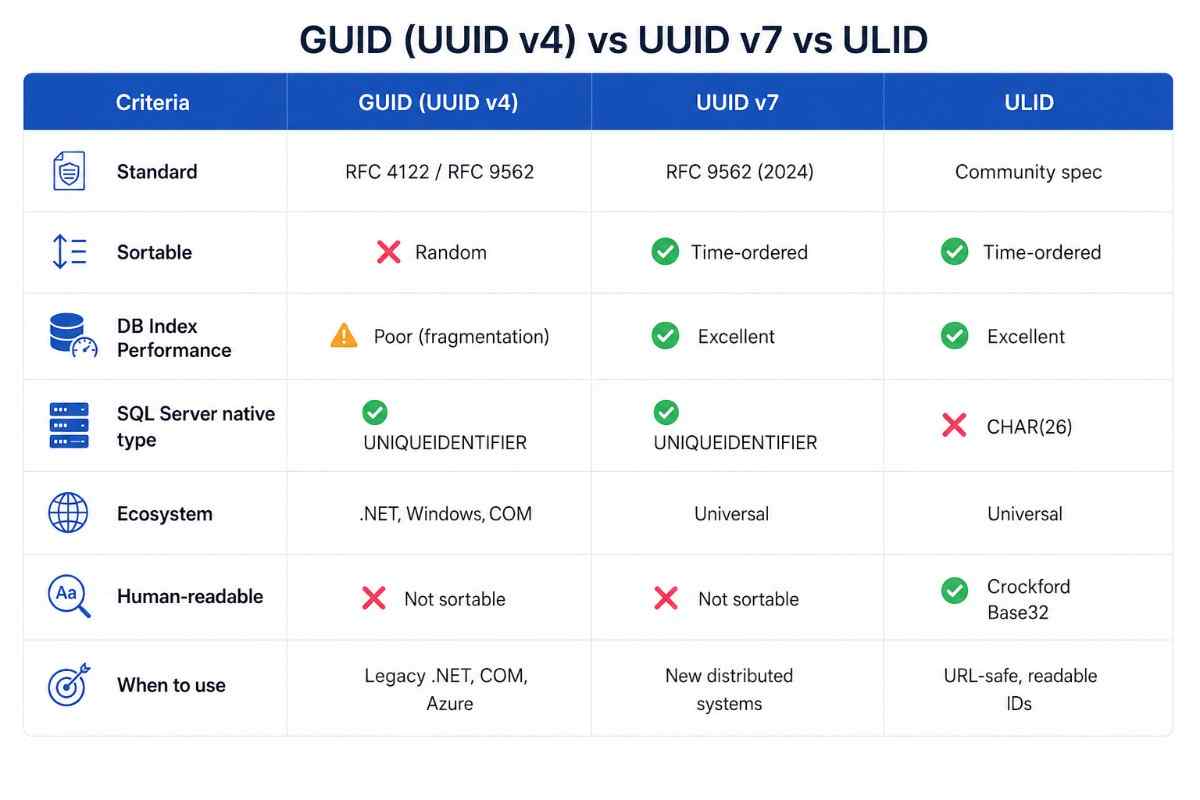
Rule of thumb: Use GUID for existing Windows/.NET/SQL Server systems where UNIQUEIDENTIFIER is already the standard. For new projects — especially those running across distributed services or microservices — consider UUID v7 which is time-ordered (better index performance), RFC-standardized, and natively supported by PostgreSQL 17, MySQL 9, and MariaDB 10.7+. Use ULID when you need URL-safe, human-sortable identifiers.
Frequently Asked Questions
Yes. A GUID and a UUID are identical in structure — both are 128-bit identifiers formatted as 32 hex digits in five groups separated by hyphens. "GUID" is Microsoft's term (used in .NET, SQL Server, and Windows); "UUID" is the open-standard term (used in Linux, cloud, and web contexts). RFC 4122 explicitly states the two terms are interchangeable.
A GUID v4 has 122 bits of randomness, yielding 2¹²² ≈ 5.3 × 10³⁶ possible values. At a generation rate of 1 billion GUIDs per second across all computers on Earth, it would take approximately 85 years before a collision becomes statistically likely. For all practical purposes, GUIDs are globally unique.
Use Guid.NewGuid() from the System namespace. For the Windows Registry format (uppercase with braces), use Guid.NewGuid().ToString("B").ToUpper(). For database use, assign a Guid property directly — Entity Framework Core maps it to UNIQUEIDENTIFIER in SQL Server automatically.
NEWID() generates a completely random GUID and causes index fragmentation when used as a clustered primary key (each insert goes to a random position in the B-tree). NEWSEQUENTIALID() generates a monotonically increasing GUID on the current server, reducing fragmentation, but it only works as a column default (not in queries) and resets on server restart. For new projects, generating a UUID v7 client-side eliminates both limitations.
Yes - UNIQUEIDENTIFIER is a native SQL Server type that stores GUIDs as 16 bytes. The main consideration is index performance: random GUIDs (from NEWID()) cause B-tree fragmentation on clustered indexes. To avoid this, either use NEWSEQUENTIALID() as a default, generate UUID v7 values client-side (time-ordered), or add FILL_FACTOR and regular index rebuild jobs to your maintenance plan.
This is purely a Windows convention established with COM in the early 1990s. The {UPPERCASE-GUID} format (known as the "B" format in .NET's ToString("B")) was chosen to visually distinguish GUIDs from other registry values and to match the C-language struct representation used in COM interface headers. Both formats represent the same 128-bit value.
Standard GUIDs (UUID v4) are safe for URL use because their randomness makes them unpredictable - an attacker cannot guess a valid GUID. However, they are not URL-friendly (hyphens are allowed in URLs but add 4 characters). For shorter, URL-safe identifiers, consider NanoID (21 chars) or ULID (26 chars). If you need time-ordered URL-safe IDs, UUID v7 is the best modern choice.